
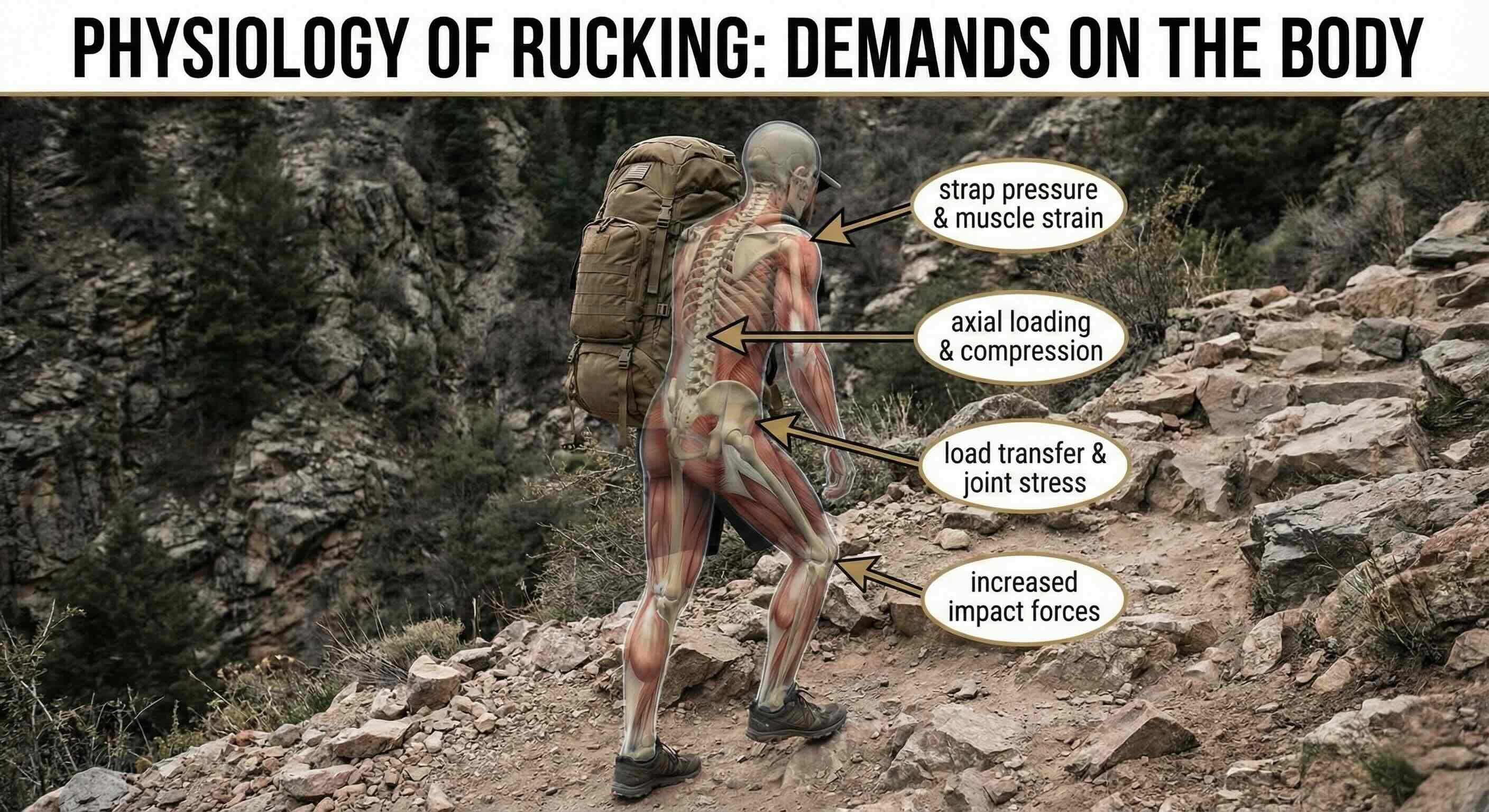
The Physiology of Heavy Pack Carry
Rucking isn't just walking with weight. It is a distinct physiological stressor that alters biomechanics, caloric demand, and structural load. Understanding these demands is the first step to mastering them.
Biomechanics of Load
When you add external load to the torso, your center of mass shifts. To compensate, the body instinctively leans forward. This *trunk flexion* increases the sheer force on the lumbar spine and alters the gait cycle. Research from military studies shows that for every 1kg of external load, ground reaction forces increase appropriately, but joint forces—specifically at the knee and hip—can increase exponentially if mechanics degrade.
The "Hunter’s Gait" must be shorter and faster than an unladen stride. By shortening stride length, you keep your feet under your center of gravity, reducing the braking force of each heel strike and minimizing impact on the knees.
The Metabolic Cost
Rucking bridges the gap between resistance training and cardiovascular endurance. It elicits a high heart rate response similar to running but with a muscular endurance component comparable to high-rep lifting.
- Caloric Burn: Carrying 30-50lbs increases caloric expenditure by 30-45% compared to walking at the same speed.
- Muscle Recruitment: The trapezius, spinal erectors, and glutes work overtime to maintain posture. This static contraction restricts blood flow, causing rapid local fatigue—often the limiting factor before your lungs give out.
Structural Adaptation
Wolff’s Law states that bones adapt to the loads under which they are placed. Consistent (but progressive) rucking increases bone density, specifically in the spine and lower extremities. However, the connective tissues—tendons and ligaments—adapt slower than muscle. This is where most hunters fail. They have the engine to push hard, but their chassis cracks.
Training Implication
Do not rush to heavy loads. Volume (time/distance) should precede intensity (weight). Allow your connective tissue 6-8 weeks to adapt to a standard base weight (e.g., 30lbs) before increasing load.
Conclusion
Respect the load. Train your posture as much as your legs. If your upper back collapses, your lungs compress, your efficiency drops, and your hunt ends early. Build the chassis, and the engine will follow.