
Glassing from the Master Logic
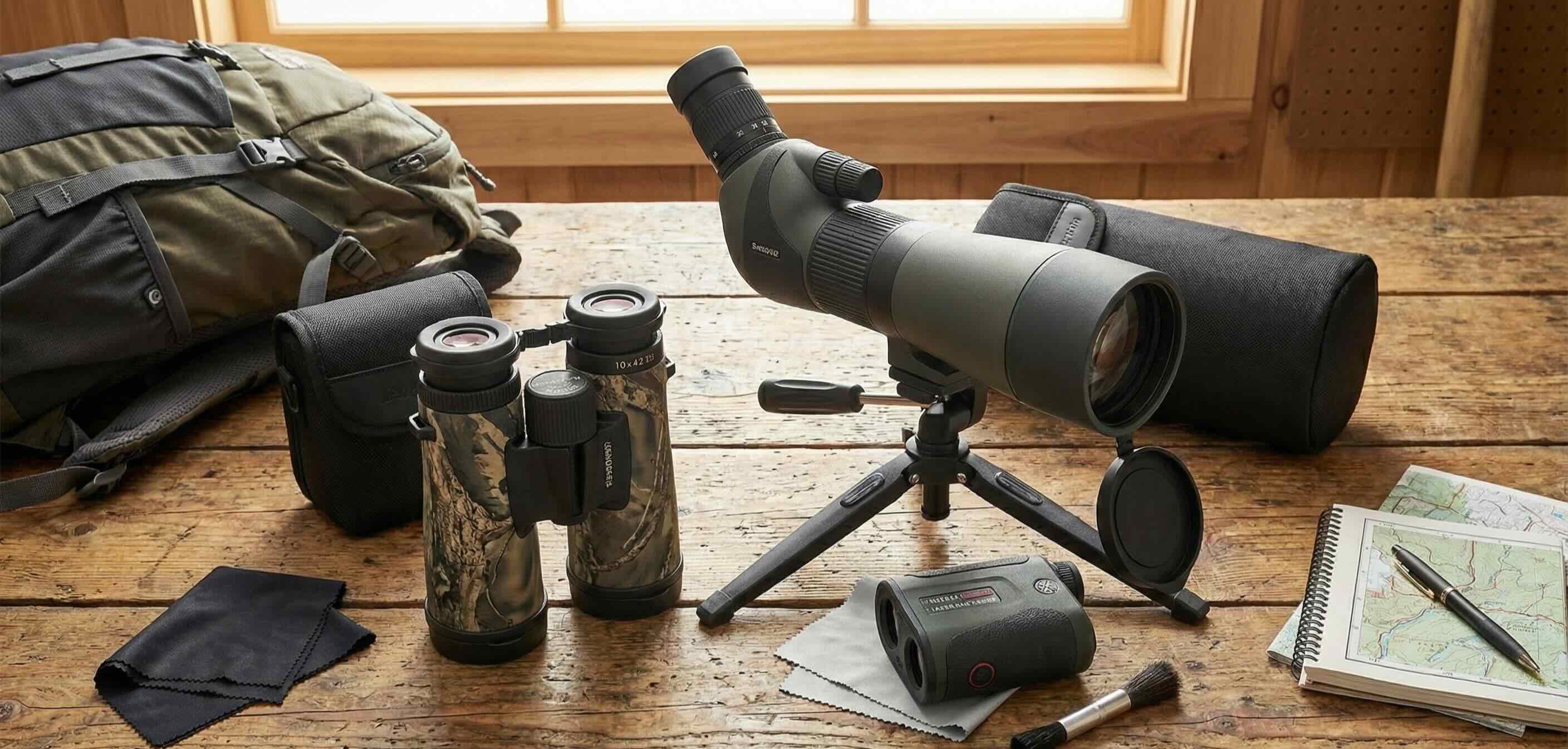
Your legs can only take you so far. Your eyes—aided by quality glass—can cover thousands of acres in minutes. The "Master Logic" of western hunting is simple: Let your glass do the walking. But owning expensive optics doesn't make you a better hunter; knowing how to use them does.
Binoculars vs. Spotting Scopes
Binoculars (10x42 or 12x50): These are for finding game. You need a wide field of view to grid-search hillsides. Use them on a tripod (absolutely mandatory) to stabilize the image. The shake from hand-holding hides movement and detail.
Spotting Scopes (20-60x): These are for evaluating game. Once you find a buck with binos, switch to the spotter to count points or check legality. Do not try to grid a mountain with a spotter; the field of view is too narrow ("looking through a straw").
The Tripod Priority
A $500 pair of binos on a tripod will outperform a $2,500 pair around your neck. Human micro-tremors blur the image, causing eye fatigue and missed details. If you are glassing for more than 30 seconds, mount them up. And get a fluid head—pan smoothly, don't chop.
The Grid Technique
Amateurs scan randomly. Pros grid. Start at the top of a ridge. Scan left to right in a straight line. Drop down one field-of-view width. Scan right to left. Repeat until you hit the valley floor. Then do it again, looking only into the shadows.
Pro Tip: Look for Parts, Not Whole Animals
Your brain looks for the silhouette of a deer. Stop that. Look for the horizontal line of a back in a vertical forest. Look for the twitch of an ear. Look for the ivory shine of an antler tip. Nature rarely creates perfect horizontal lines or rhythmic movement.